A Bookshelf Reading Tracker, Drawn Spine by Spine
A bookshelf reading tracker is a drawn shelf with one rectangle per book, standing on a ruled line the way spines stand on a real shelf. You outline a spine when a book goes on your list and color it in when you finish, so the row fills as the year goes on. Width, color, height and the label each carry one fact about the book, which is what makes a finished shelf readable at a glance.
The shelf below is a worked example, 12 finished books on one ruled line of a notebook page, titles left off. Width follows the page count, color the genre, height the rating.
One finished shelf, twelve spines
Read the shelf from left to right, in the order the books were finished. The line is 18 cm wide, which fits a US Letter or A4 page, and the twelve spines fill a little under half of it. Each carries a letter for its genre and a number at the base for its place in the year.
- A 300-page novel, 6 mm wide, blue with an F, drawn tall. One of three favorites.
- A 150-page novella, 3 mm, blue F, medium height. Too thin for a title, which sits on the facing page.
- A 450-page history, 9 mm, green with an N, medium.
- A 300-page memoir, 6 mm, orange with an M, tall. The second favorite.
- A 600-page fantasy novel, 11 mm, blue F, short. The widest spine and the biggest letdown.
- A poetry collection of about 100 pages, 2 mm, purple with a P. Barely a line, so the letter stands beside it.
- A non-fiction audiobook, 6 mm by rule, green N with a dotted fill and a small A on top.
- A 300-page novel, 6 mm, blue F, medium.
- A 250-page memoir, 5 mm, orange M, medium, with the finish date at the base instead of a number.
- A 450-page novel, 9 mm, blue F, tall. The third favorite.
- A 300-page library book, 6 mm, green N, outline only, because borrowed books stay unfilled.
- A 350-page novel, 7 mm, blue F, medium.
The row answers three questions at once. Six of the twelve spines are blue, so half the year was fiction. The three tall spines are two novels and a memoir. The two widest books, the history and the fantasy, take up about as much shelf as the five thinnest together.
Spine width shows length
The scale comes from how paperbacks are made. Every leaf adds the same thickness of paper, so the spine grows in step with the page count, and a book twice as long is about twice as wide. The example takes a 300-page paperback as about 17 mm, so measure one of your own to set the scale.
At full size, 30 books would need more than half a meter of line, so draw at one third. A 150-page book becomes 3 mm, 300 pages 6 mm, 450 pages 9 mm and 600 pages 11 mm. Hardcovers and heavier paper run wider, so hold a ruler against one of your own 300-page paperbacks before you trust the numbers. What about audiobooks? They have no pages, so give each the same fixed width, 6 mm in the example, and a small A on top.
Color shows genre
One color per genre, and no more than five or six, or the key stops fitting in the corner of the page. The example uses four colors and pairs each with a letter, so a spine still reads when two pencils look alike.
- Blue with an F for fiction
- Green with an N for non-fiction
- Orange with an M for memoir
- Purple with a P for poetry
The National Eye Institute says about 1 in 12 men have color vision deficiency, and red against green is the pair that often causes trouble. Keep those two apart on your key. A letter or a hatch pattern on every color costs one pencil stroke per spine and lets a partner or a teacher read the shelf too.
Height shows the rating, fill shows the source
Height is the one dimension a real shelf leaves free, so the example spends it on the rating. Draw the ordinary spine about 2 cm tall. Add 1 cm for a book you loved and take 1 cm off for one you were glad to finish. Three heights are enough, because nobody rereads a shelf to check whether a spine is 2.4 or 2.6 cm tall.
The fill carries a fourth fact. Solid for a book you own, outline only for a library loan, dotted or hatched for an audiobook, as spines 7 and 11 show. Keep it to one fill per spine. A hatched outline on a tall purple spine takes decoding, and the point of the drawing is that it needs none.
The label names the book
Write the title up the side of each spine in pencil, small enough to fit, and go over it in pen once the book is done, because planned titles change. Put the finish date or a running number at the base, and the shelf doubles as a count.
A 3 mm spine has no room for a title, and a 2 mm one barely has room for a letter. Write initials or the first two words, or keep a numbered list on the facing page and let the spine carry only the number. On thin notebook paper, colored pencil and a fine-point pen stay put. Broad markers soak through, so test one in a margin first.
Drawing your own bookshelf reading tracker
Rule one shelf line and leave room above it for the tallest spine. A 12 cm line fits an A5 notebook page and holds about 20 average paperbacks at the one-third scale. An 18 cm line fits US Letter or A4 and holds about 30. Rule the next line 6 to 7 cm lower, which gives three shelves on A5 and three or four on a full page.
Decide what one shelf means before you draw the second. A shelf can be a month, a quarter, the next ten books or one genre. If you want to count the whole year on a single page, three 18 cm shelves hold about 90 books. A row of outlined spines, colored one at a time, also makes a reading challenge visible on the wall. A child of 7 or 8 can draw and color the spines once an adult has ruled the lines.
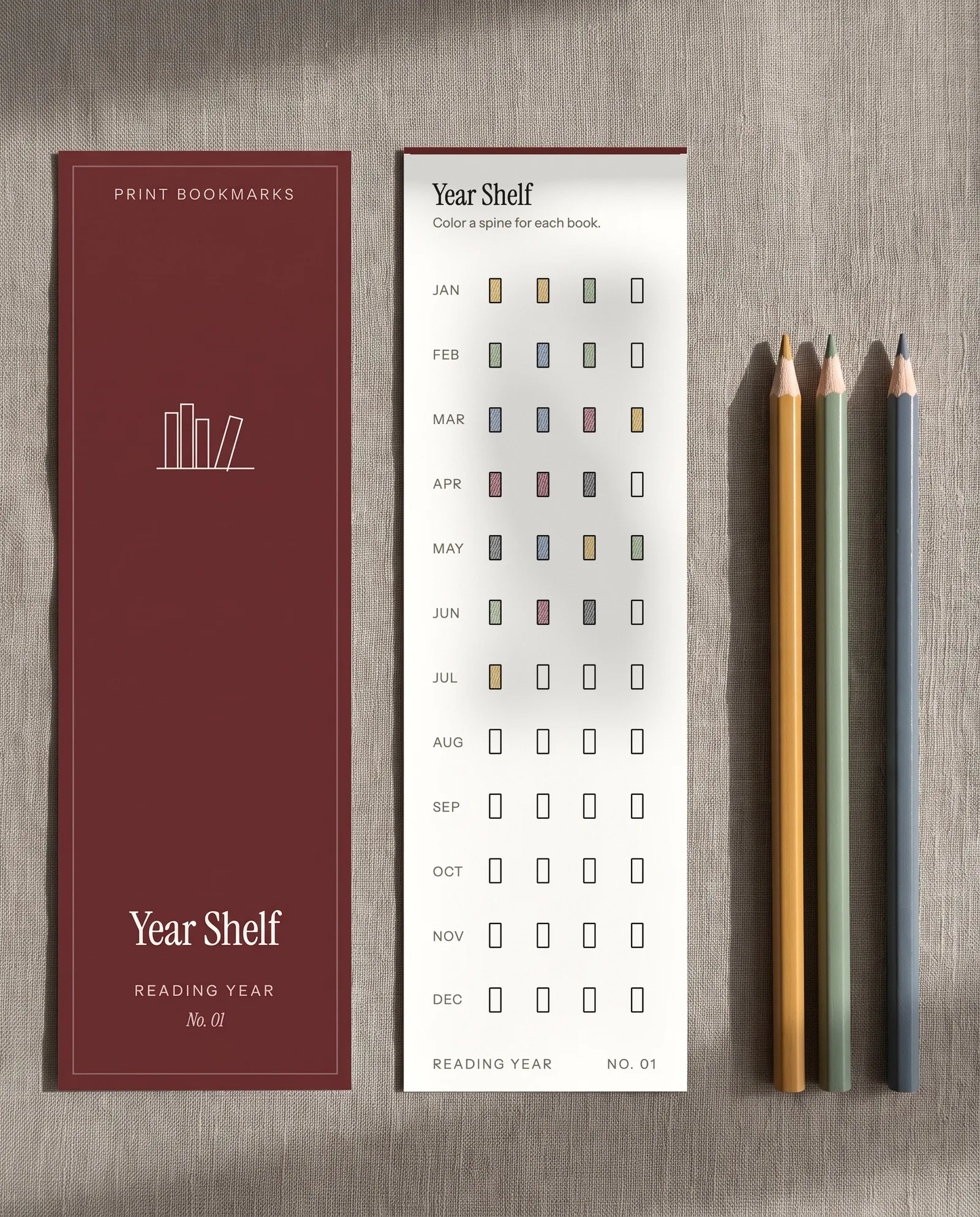
To skip the ruler, the free reading tracker bookmarks and one-page logs include The TBR Shelf, a page with five shelves of empty spines to title and color in. The Reading Year set of six bookmarks has a shelf to color by month. On both, the spines are already drawn, so the widths cannot follow page counts. If you want fat books to look fat, draw your own.
When the shelf is full
A full shelf is the signal to rule the next line, 6 to 7 cm below, and to carry the key down with it. Keep the numbers running, so the first spine on shelf two is book 31, and write the month the shelf filled at its right-hand end. On a shelf per month, an empty stretch after a thin month is part of the record.
When the page is full, start the new year on a fresh page and leave the old one alone. If ruling lines has become a chore, other ways to track books take less setup. For a child over the summer, the free summer reading log has ten books to color at the top, one a week. Otherwise, rule the next line the day the twelfth spine gets its color, while the pencils are still out.
Sources
- National Eye Institute, Color Blindness (n.d.) (last checked 2026-10-05)