A Yearly Reading Tracker, Quarter by Quarter

Decide what you will count before January 1, because a yearly reading tracker only works when a line written in December means the same as one written in January. Count finished books unless you have a reason not to, write the rules on the tracker itself, and open it for a check four times a year. This walk-through takes the year in quarters, from the January set-up to the December review.
The year in four check-ins
A yearly tracker needs four appointments, one per quarter, each about 10 minutes long. January is the set-up. In April you check that the unit and the goal are working, and in July you compare the count with the halfway mark. December is the review and next year's first line. Between those four sittings the tracker asks for one line per finished book, written at the last page.
| Quarter | What to do | What to record |
|---|---|---|
| January | Choose the unit, write the counting rules, set the goal from last year's total, pick where the tracker lives | The unit, the rules, the goal and the halfway number |
| April | Count what is on the tracker, fill gaps from library and e-reader history, judge whether the unit frustrates you | The count at the end of March, and any second unit you try |
| July | Compare the count with the halfway number, raise or lower the goal, change what you read if you are behind | The count at the end of June and the adjusted goal |
| December | Answer the five review questions, pick the best five, set next year's goal | The final total, the answers and next year's first line |
January: set up the yearly reading tracker
Pick the unit first, because the unit decides which tracker fits. Finished books is the count that is hardest to get wrong, and it works for print, e-books and audio alike. Pages treat a 900-page novel and a novella fairly but leave an audiobook with nothing to count. Minutes suit busy weeks and audio, and they ask for a note after every sitting.
Then write the rules on the tracker, in the margin or on the back, so the December total means what you think it means. Does a re-read count? Goodreads says re-reads count toward its Reading Challenge, and you can adopt that rule or write your own. Decide the same way about a book abandoned at page 100, a story collection read in pieces, and audiobooks. Many readers count audio as books, since the story is finished either way. A small mark next to the title keeps the two apart.
Set the goal from last year's total. For scale, a Pew Research Center survey from October 2025 found that 25% of U.S. adults had read no books in the past 12 months. Another 38% had read one to five, so the median reader sits in that bracket. Turn the goal into a pace you can check against. Twelve books is one a month, 24 is two and 52 is one a week. Write the halfway number beside the goal now, in January, while it is plain arithmetic.
Where the tracker lives decides whether it survives. A bookmark sits in the book, so you update it at the last page. A one-page sheet on a cupboard door shows the year at a glance. A notebook page holds notes as well as a count, and an app counts for you and draws charts.
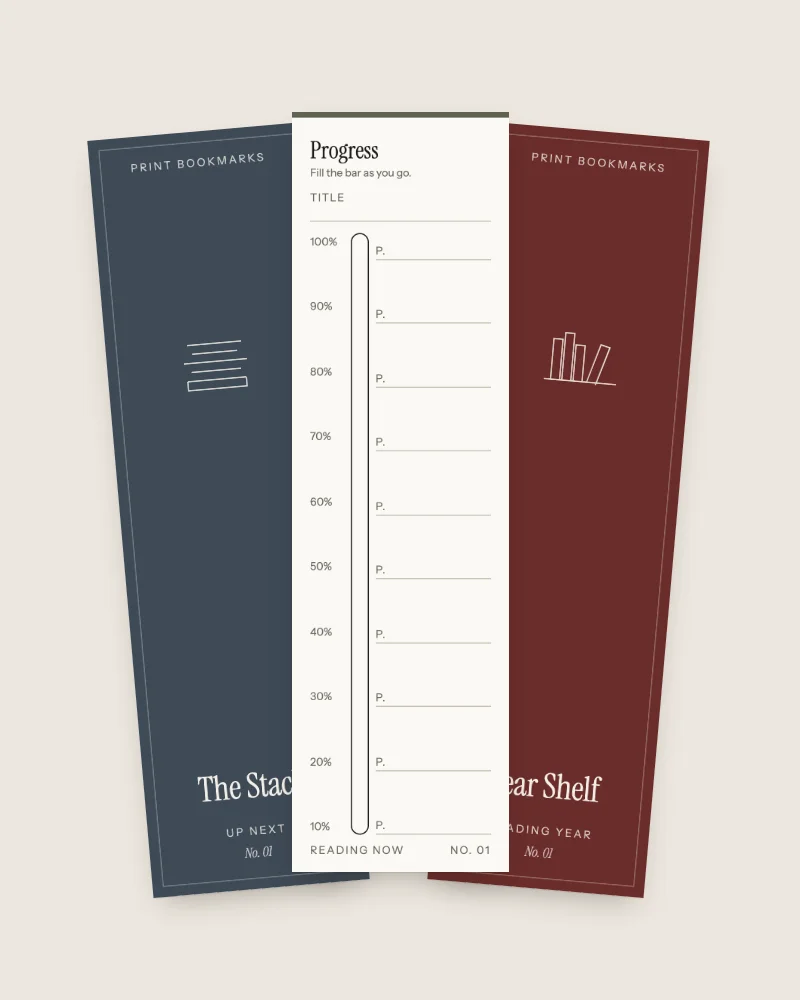
The free reading tracker bookmarks page has two paper versions built for a whole year. Reading Year is a set of six bookmarks. They hold a shelf to color by month, a goal jar, a finished log, twelve challenge prompts, a tally by genre and your best five. The Year in Books is one sheet with twelve months and room for five books each, so it holds 60 titles.
Past 60 books, an app is the better choice. The same goes if you want Kindle books counted without writing anything, which Goodreads does once you link your Amazon account. For the full weighing of paper against apps, see the article on choosing a book tracker.
April: the first check, three months in
By the end of March the tracker should hold a quarter of the goal, so 3 books on a goal of 12, 6 on 24 and 13 on 52. Sit down with it once in the first week of April and count. A gap of a book or two after a slow February is normal and needs no change. A gap of half the quarter says something about the goal or the unit, and April is early enough to fix either.
Fill the gaps from evidence. Your library account, your e-reader history and the pile by the bed all show what you finished. A title copied from them in April is as good as one written at the last page. Reconstructing three months from memory in one sitting is how books go missing. Even then, a missing title costs less than a tracker you stop trusting, so write what you can and move on.
If every long book has felt like a penalty, try a second unit for one month. The minutes bookmark on the free tracker sheet has a box for every day of the month. A line on a wall calendar does the same job. A reader who wants days and minutes for every month is better off with a log page for each month than with a yearly sheet. Keep the main unit as it is, though, because two units added into one total make the December number mean nothing.
July: the halfway point
At the end of June the count meets the halfway number from January: 6 on a goal of 12, 12 on 24, 26 on 52. Reaching it a month early means the goal was low and you can raise it. Arriving a few books short means the second half needs a lower goal or a change in what you read. Both are honest choices. A goal that no longer fits the year is a tracker you stop opening in September.
If you are behind, change the books before you change the number. Choose shorter titles for a stretch, or add an audiobook to the walk or drive you already make, if audio counts under your rules. Three or four short books in July bring the halfway mark back within reach. When the problem is picking the next book, a challenge with prompts hands you one, which a blank line on a tracker never will.
For scale, the same Pew survey put 14% of U.S. adults at more than 20 books in the past 12 months. A reader with 10 books on the tracker in July is on course to finish the year in that group. That is worth knowing before anyone calls a 20-book year small.
December: the review and next year's first line
Give the review one sitting in the last week of December, with the tracker and a pen, and write the answers on its last page.
- How many books did you finish, and how does that compare with the goal?
- Which months were full, and which were empty?
- Which kind of book did you read most, and which did you skip?
- Which five were the best, and what do they share?
- What number fits next year, and why?
The answers come faster on paper built for them. On the Reading Year set, the shelf colored by month answers the second question at a glance. The tally by genre answers the third, and the best five bookmark answers the fourth. On a plain list, tick the titles per month in pencil and circle the five favorites. An app answers the first three with a chart and leaves the last two to you.
Then write next year's first line before the year ends. The unit, the rules and the goal go at the top of a fresh tracker, with the halfway number beside the goal. If the goal moved in July, start from the total you reached. One line covers it, something like finished books, re-reads count, audio counts with a mark, goal 24, 12 by June 30. A tracker that begins on January 1 with its rules already written is the one you still have in April.
Sources
- Pew Research Center, Americans still opt for print books over digital or audio versions; few are in book clubs (2026) (last checked 2026-10-05)
- Goodreads, Join the Goodreads Reading Challenge (2026) (last checked 2026-10-05)